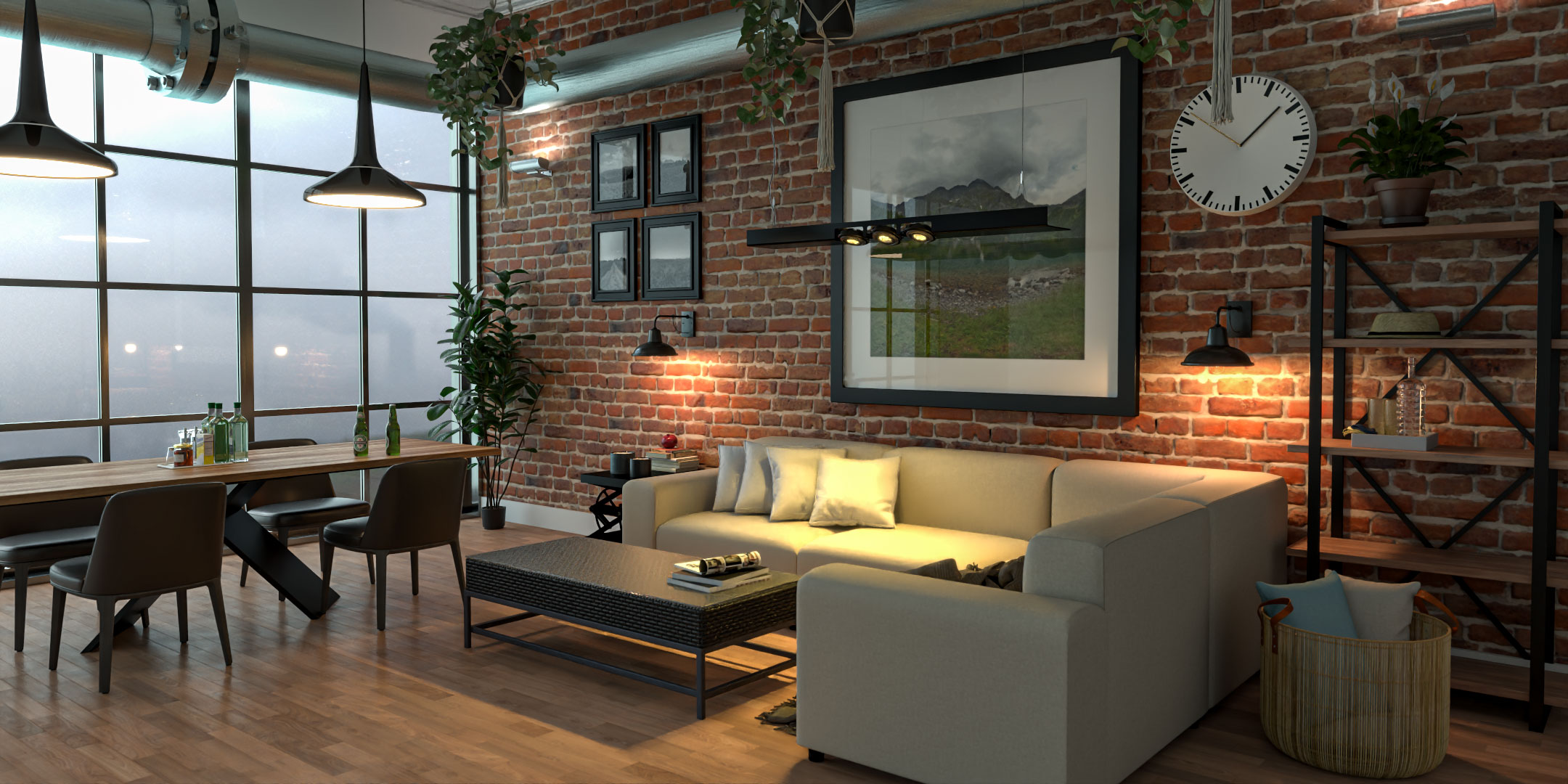
Photorealistic architectural rendering is the process of creating CGI images of buildings and interiors that closely reproduce the visual qualities of real-world photography.
The most convincing architectural renders combine accurate geometry, realistic materials, natural lighting, carefully composed cameras, believable imperfections and appropriate environmental context.
But photorealism is not simply about increasing render quality or using more powerful software.
A technically perfect image can still look artificial.
What makes an architectural rendering convincing is the combination of dozens of subtle decisions that make the viewer accept the image as a believable representation of a real place.
For architects, property developers and interior designers, this distinction matters. High-quality architectural visualisation can communicate an unbuilt project with a level of clarity that drawings alone cannot provide.
What Is Photorealistic Architectural Rendering?
Photorealistic architectural rendering is the creation of computer-generated imagery designed to resemble professional architectural photography.
A three-dimensional model of the proposed building or interior is created or prepared from architectural information. Materials, textures, furniture, landscaping, lighting and environmental elements are then added before the scene is rendered into an image.
The objective is not necessarily to convince somebody that the image is literally a photograph.
Instead, good photorealistic rendering removes the visual distractions that make CGI feel artificial.
The viewer should be able to concentrate on the architecture.
This is one reason 3D architectural rendering has become such an important communication tool for projects that have not yet been constructed.
Photorealism Starts With Accurate Geometry
No amount of sophisticated lighting can rescue an inaccurate model.
Architectural proportions need to be correct before realism can develop.
Walls, windows, doors, roof structures, stairs, furniture and architectural details must correspond with the design information supplied by the architect or client.
Small details also matter.
Real buildings contain:
window reveals
skirting
joints
trims
frames
handles
drainage details
roof edges
material transitions
construction tolerances
A model that contains only large geometric forms can look unnaturally clean, even when the overall architecture is correct.
This is why understanding the distinction between 3D modelling and 3D rendering is important. Rendering can only visualise the information contained within the underlying scene.
Materials Must Behave Like Real Materials
One of the quickest ways to identify weak CGI is through its materials.
Real surfaces react to light differently.
Glass reflects and transmits light. Polished stone behaves differently from unfinished concrete. Brushed metal does not reflect its surroundings in the same way as chrome. Timber contains variation in grain, colour and roughness.
A convincing material therefore requires more than applying a photograph as a texture.
Its properties may include:
colour
reflectivity
roughness
transparency
surface relief
texture scale
imperfections
edge behaviour
These characteristics need to work together.
A brick texture might be photographically accurate but still look wrong if the bricks are incorrectly scaled. Timber can look artificial if every board repeats exactly. Stone can appear like plastic if its surface is too uniformly reflective.
Photorealism comes from reproducing how materials interact with light, not simply what they look like in a reference photograph.
Perfect Surfaces Often Look Fake
Reality is rarely perfect.
Walls contain subtle variation. Glass has reflections. Timber changes from board to board. Concrete contains tonal differences. Metal develops minor surface irregularities.
CGI naturally begins from mathematical perfection.
Every wall can be completely straight. Every surface can be spotless. Every object can be positioned precisely.
That can become a problem.
The best architectural visualisation introduces controlled imperfection.
This does not mean deliberately making the architecture look poorly constructed. It means removing the sterile perfection that makes a computer-generated scene immediately identifiable.
Subtle variation is usually more convincing than obvious dirt or damage.
Lighting Is One of the Biggest Factors in Photorealism
Light defines almost everything we see.
It reveals form, texture, depth and scale.
In architectural visualisation, unrealistic lighting can make even an excellent 3D model look artificial.
Natural exterior lighting depends on:
sun position
time of day
season
geographical orientation
cloud conditions
surrounding buildings
landscape
atmospheric conditions
Interior lighting introduces another layer of complexity.
Daylight may enter through windows while artificial fixtures create additional pools of light with different intensities and colour temperatures.
A convincing interior render needs these sources to interact naturally.
The objective is not simply to make the image bright enough. Light should explain the architecture.
Shadows Need to Make Physical Sense
Shadows are an important visual cue because the human eye instinctively understands how objects should sit within an environment.
When shadows are missing, excessively sharp or inconsistent with the primary light source, objects can appear to float.
This is especially noticeable with:
furniture
people
vehicles
vegetation
decorative objects
buildings inserted into photographic environments
Contact shadows are particularly important.
The subtle darkness where an object meets another surface helps establish weight and position.
Without it, even a highly detailed model can appear disconnected from its surroundings.
Realistic Glass Is Surprisingly Difficult
Glass is one of the most common materials in contemporary architecture and one of the easiest to get wrong.
Real glazing is neither completely transparent nor simply reflective.
What appears on the surface depends on:
viewing angle
lighting
interior brightness
exterior brightness
surrounding buildings
sky conditions
glass specification
Large areas of glazing also reveal what is happening inside the building.
If every window contains identical reflections or completely black interiors, the façade can quickly look artificial.
For commercial and residential developments, careful glazing treatment can significantly improve the credibility of an exterior render.
Composition Matters as Much as Rendering Technology
Photorealism does not automatically create a good architectural image.
The camera still needs to be positioned intelligently.
Architectural photographers carefully consider viewpoint, lens choice, framing, vertical alignment and visual hierarchy.
CGI should do the same.
The strongest camera angle is rarely the one that simply shows the largest amount of the building.
Instead, the viewpoint should communicate something specific.
It might emphasise:
the main entrance
architectural form
landscaping
a relationship with neighbouring buildings
an important interior feature
the scale of a development
the experience of approaching the property
This is where architectural visualisation moves beyond technical rendering and becomes visual communication.
Camera Height Changes How Architecture Feels
Camera height is a deceptively important decision.
A viewpoint around human eye level can make the viewer feel physically present within the environment.
Higher viewpoints can explain layouts and larger developments.
Very low viewpoints can make architecture feel dramatic and monumental.
There is no universal correct height.
The important question is what the image needs to communicate.
For property marketing, a natural human perspective often helps potential buyers imagine themselves within the environment.
For masterplans and large housing developments, an elevated viewpoint may communicate considerably more information.
Lens Choice Can Make or Break a Render
Extremely wide lenses can make interiors appear larger than they really are.
They can also stretch objects near the edge of the image and distort architectural proportions.
A more restrained lens can produce an image that feels closer to professional architectural photography.
This is particularly important for photorealistic interior visualisation, where the temptation to fit an entire room into one image can result in unnatural perspectives.
Sometimes showing slightly less creates a much more believable image.
Furniture and Objects Need to Feel Lived In
An empty architectural model rarely feels real.
Furniture and accessories establish scale and function, but simply filling a room with expensive 3D assets is not enough.
Objects need believable relationships.
Dining chairs should not all look mathematically identical.
Cushions do not need perfect symmetry.
Books, lamps, artwork and accessories should feel intentionally positioned without making the environment excessively staged.
The objective is controlled naturalism.
The scene should feel designed, but it should also feel capable of being inhabited.
People Can Improve or Destroy Realism
People immediately give architectural images scale.
They can also make an otherwise excellent render look artificial.
Common problems include people who:
are incorrectly scaled
have inconsistent lighting
cast the wrong shadows
appear excessively sharp
are dressed inappropriately for the environment
appear to float
repeat throughout the image
People should support the architecture rather than become the subject unless the visual brief specifically requires it.
Their position should also make sense.
Someone should not be walking through landscaping, staring at a wall or standing in the middle of a road simply because an empty part of the composition needed filling.
Vegetation Needs Variation
Nature is extremely complex.
This makes vegetation one of the most challenging elements to reproduce convincingly.
Repeating the same tree or shrub across a landscape quickly exposes the digital nature of the scene.
Real vegetation varies in:
height
orientation
colour
density
age
shape
Landscape visualisation therefore benefits from controlled randomness.
Grass should not resemble a perfectly uniform carpet. Trees should not have identical rotations. Planting should respond to the landscape design rather than simply fill empty areas.
For exterior architectural rendering, vegetation often represents a substantial proportion of the final image, so its quality can strongly influence overall realism.
Context Makes Architecture Believable
Buildings exist within environments.
Roads, pavements, neighbouring properties, vegetation, vehicles, street furniture and people all provide visual evidence of scale and location.
Without context, a building may look like a 3D model floating within a generic landscape.
This is particularly important when visualising UK developments.
A convincing British residential street should feel different from a development in California, Dubai or southern Europe.
Architecture, vegetation, road markings, vehicles, weather and the character of the surrounding environment all contribute to geographical credibility.
Context therefore needs the same attention as the building itself.
Interior Lighting Requires Balance
Interior rendering presents a particular challenge because several lighting systems can operate simultaneously.
Daylight may enter through windows while ceiling lights, lamps, LED strips and decorative fixtures contribute artificial illumination.
If artificial lights are too bright, the room can resemble a showroom.
If daylight is too strong, windows can become completely overexposed.
A convincing interior image usually balances these sources so that the room retains depth.
This is especially important in interior design visualisation, where materials, furniture and lighting need to communicate the intended design together.
Reflections Need Something to Reflect
Reflective materials depend on their surroundings.
This sounds obvious, but it is frequently overlooked.
Glass, polished stone, metals, glossy furniture and water all reveal information about the environment around them.
If the surrounding scene lacks sufficient detail, reflections can appear empty or repetitive.
For exterior imagery, this may mean modelling or representing neighbouring buildings and landscape beyond what the camera directly sees.
For interiors, objects outside the camera frame may still influence reflections.
A convincing render therefore contains more information than the final image appears to show.
Post-Production Should Enhance, Not Rescue, the Render
Post-production is an important stage of professional architectural visualisation.
It can refine:
exposure
contrast
colour
atmosphere
vegetation
people
skies
depth
reflections
small imperfections
However, post-production should not compensate for fundamental problems with geometry, materials or lighting.
If the underlying render is incorrect, extensive image manipulation can create inconsistencies rather than realism.
The strongest workflow begins with a well-built 3D scene and uses post-production to refine the final image.
Depth Makes an Image Feel Photographic
Real photographs contain visual depth.
Objects close to the camera behave differently from objects hundreds of metres away.
Atmospheric perspective gradually reduces contrast and saturation over distance.
Foreground elements can also create layers within the composition.
A convincing architectural image often contains a clear relationship between:
foreground
subject
background
This gives the viewer spatial information and prevents the image from feeling flat.
Depth can be particularly effective in large exterior scenes and masterplan visualisations.
Weather Does Not Need to Be Perfect
One of the easiest ways to make CGI feel artificial is to create an impossibly perfect environment.
Completely blue skies, flawless landscaping, spotless roads and identical bright sunshine can produce imagery that feels more like advertising illustration than architectural photography.
Sometimes a slightly overcast sky, softer sunlight or subtle atmospheric haze creates greater realism.
The appropriate weather depends on the project's purpose.
Marketing imagery may deliberately use attractive conditions, but attractive does not have to mean artificial.
Photorealism Is Not the Same as Maximum Detail
More detail does not automatically produce greater realism.
The detail needs to appear where the viewer expects it.
A distant building does not require the same level of modelling as a façade immediately beside the camera.
A small object in the background may require only enough information to produce the correct silhouette, colour and shadow.
Professional visualisation therefore involves deciding where detail matters.
This helps direct production effort toward the elements that genuinely influence the final image.
Rendering Software Is Only Part of the Equation
Modern rendering engines can simulate physically accurate lighting, reflections, materials and global illumination to an extraordinary level.
However, software does not automatically produce photorealism.
Two artists can use the same software and create completely different results.
Realism depends on:
modelling
material creation
lighting
camera composition
environmental design
artistic judgement
technical knowledge
post-production
This is why asking which 3D rendering software is best tells only part of the story.
The software is a tool. The decisions made with it determine the result.
Real-Time Rendering Has Changed Architectural Visualisation
Traditional rendering can require substantial processing time to calculate complex lighting and materials.
Real-time rendering has changed that relationship.
Modern GPU-based workflows allow visualisers to see lighting, materials and environmental changes almost immediately while developing a scene.
This can accelerate experimentation and make interactive experiences possible.
Our guide to real-time 3D rendering explains how this differs from conventional rendering workflows.
The technology is particularly valuable for animation, 360-degree imagery and interactive architectural experiences.
Still Images Are Only One Form of Photorealistic Visualisation
A photorealistic 3D environment can become the foundation for much more than individual images.
The same project can potentially generate:
exterior renders
interior renders
animations
360-degree panoramas
virtual reality experiences
marketing content
3D walkthroughs and floor-plan visualisation can help communicate movement and spatial relationships that are difficult to understand from static imagery alone.
Similarly, 360-degree renderings allow viewers to look around a proposed environment rather than seeing only a predetermined camera angle.
Why Photorealism Matters for Property Development
A development that has not been built cannot be photographed.
Yet developers may need imagery months or years before completion.
CGI can provide those visual assets.
High-quality architectural rendering can support:
pre-construction marketing
off-plan sales
investor presentations
stakeholder communication
design development
brochures
websites
advertising
social media
For property developers, the objective is not photorealism purely for its own sake.
The objective is communication.
Our guide to CGI for property developers and off-plan sales explores how architectural imagery can become part of the wider development marketing process.
Accuracy Matters as Much as Beauty
There is an important distinction between creating a beautiful image and creating an accurate architectural visualisation.
The two should ideally work together.
A dramatic sunset might create an attractive image, but it should not disguise important architectural information.
A luxurious interior should not contain finishes that differ significantly from the actual specification unless they are clearly presented as conceptual options.
This becomes increasingly important as a project progresses through the design process.
CGI support across different design stages can evolve from conceptual communication toward increasingly detailed representations as more project information becomes available.
Can AI Create Photorealistic Architectural Renders?
AI-generated imagery can produce extremely realistic-looking architecture.
However, visual realism and architectural accuracy are not the same thing.
A generated image may look convincing while changing window positions, materials, dimensions, structural details or surrounding features.
For concept exploration, this flexibility can be useful.
For project-specific architectural visualisation, maintaining control over geometry and design information is usually much more important.
This distinction becomes particularly significant when the CGI represents a development that clients, investors or buyers expect to resemble the eventual project.
How Can You Tell If an Architectural Render Is Good?
Do not judge the image only by asking whether it looks like a photograph.
Ask whether the image successfully communicates the project.
Look at:
architectural accuracy
material realism
lighting
scale
composition
landscaping
context
people
reflections
atmosphere
overall credibility
Then consider whether all those elements work together.
A technically impressive image can still fail if the architecture becomes secondary to visual effects.
The best architectural renders make the project itself convincing.
Photorealistic Architectural Rendering With Luxe3D
Luxe3D creates photorealistic architectural visualisation for architects, property developers, interior designers and businesses across the UK.
Our 3D design and rendering services can transform architectural drawings and design information into detailed CGI for interiors, exteriors and larger developments.
Projects can also extend beyond still imagery through architectural animation, interactive visualisation, 360-degree rendering and VR.
You can explore examples of completed work in the Luxe3D portfolio.
If you have an upcoming project, contact Luxe3D to discuss your drawings, project requirements and the type of architectural visualisation required.
Final Thoughts
Photorealistic architectural rendering is convincing when nothing unnecessarily reminds the viewer that they are looking at a computer-generated image.
That does not come from one setting, one piece of software or one rendering technique.
It comes from accurate modelling, physically believable materials, natural lighting, thoughtful camera composition, appropriate context and hundreds of small visual decisions working together.
The best architectural CGI is not necessarily the image with the most detail or the most dramatic lighting.
It is the image where the architecture feels believable.
When geometry, materials, light, landscape, people and atmosphere all support the same visual story, the technology begins to disappear.
And the viewer starts concentrating on the building instead.